
The digital economy is creating new opportunities for communities across the Philippines, but taking advantage of those opportunities requires people with relevant, practical, and continuously updated skills.
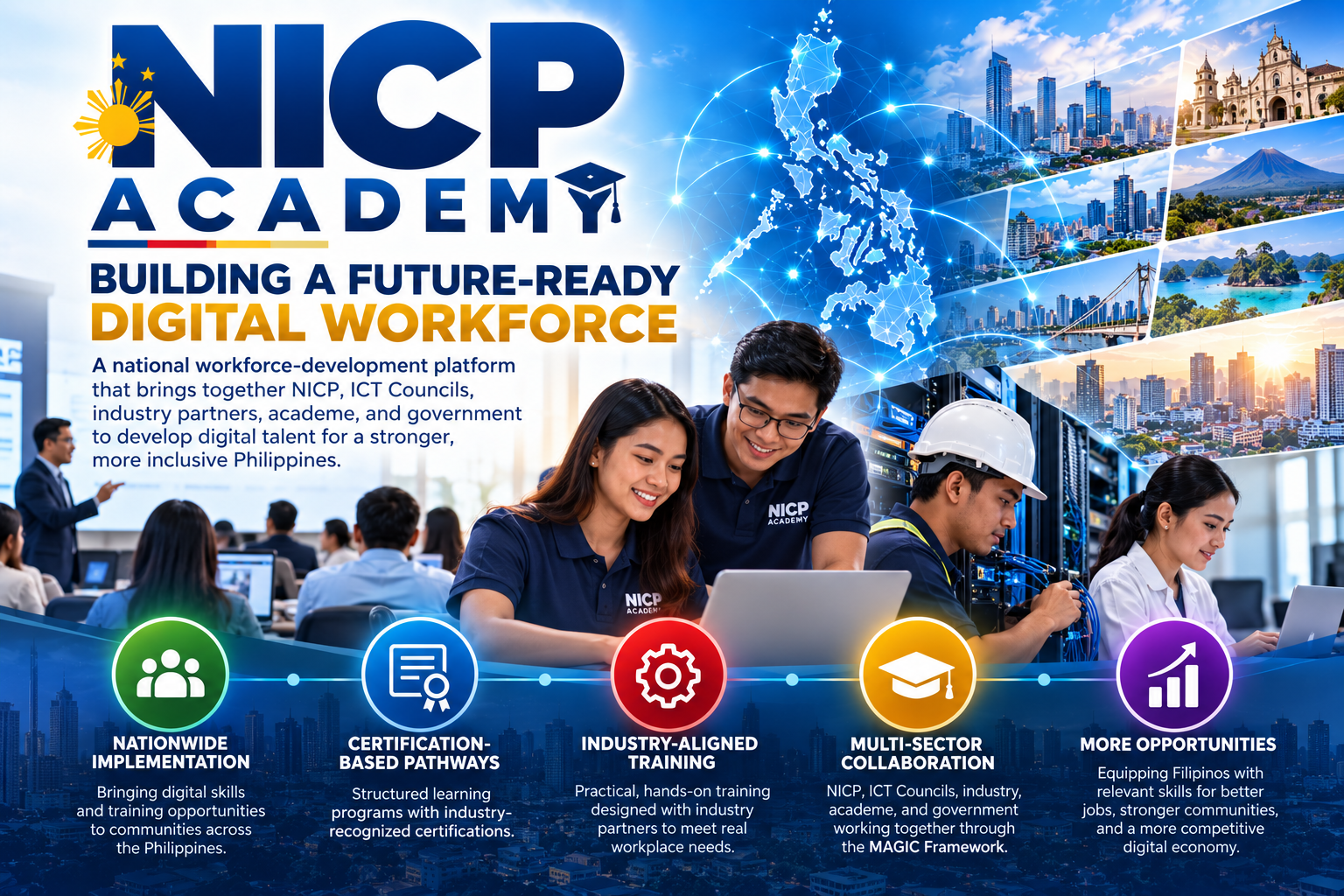
The NICP Academy is presented by the National ICT Confederation of the Philippines (NICP) as a national workforce-development platform designed to help address this need. It brings together NICP, local ICT councils, industry partners, academe, and government in a collaborative approach to developing digital talent.
At the heart of this approach is the MAGIC Framework — Making Academe, Government, Industry Collaborate.
Turning Collaboration Into Workforce Development
The MAGIC Framework emphasizes that workforce development is most effective when education, government, and industry work together.
NICP Academy provides a mechanism for putting that principle into practice.
Through collaboration with ICT councils and other stakeholders, the Academy can help connect training opportunities with the needs of local communities and the requirements of the digital economy.
This creates a pathway where:
Industry identifies skills requirements → Academe and training providers develop capabilities → ICT Councils connect local stakeholders → Government supports the ecosystem → Learners gain industry-relevant skills.
The result is a more connected approach to digital workforce development.
A Nationwide Approach
One of the key features highlighted by the public NICP Academy materials is its nationwide implementation.
Rather than concentrating workforce-development activities in a single location, the Academy works through the network of ICT councils and partner organizations across the country.
This provides an opportunity to bring relevant training closer to different regions and communities.
For local ICT councils, the Academy can become a platform for connecting their communities with:
- Digital skills training
- Industry certification
- Technology professionals
- Training institutions
- Industry partners
- Employment and career opportunities
- Continuing professional development
The nationwide approach also allows local stakeholders to participate in a broader national ICT ecosystem.
Certification-Based Learning Pathways
Another important component of the NICP Academy model is its emphasis on certification-based pathways.
Certifications can provide learners and professionals with a way to demonstrate specific technical competencies. For employers, recognized certifications can also provide additional information when assessing potential talent.
The Academy’s public course offerings illustrate this approach through specialized technical training, including areas such as structured cabling, fiber-optic systems, GPON/FTTX cabling, and CCTV cabling solutions.
These types of programs focus on practical technical competencies that can be applied in actual workplace environments.
Industry-Aligned Training
Technology changes rapidly. Skills that are relevant today can evolve as new technologies, platforms, and business models emerge.
For this reason, workforce development needs to remain connected to industry requirements.
NICP Academy’s collaboration with industry partners provides a mechanism for training programs to reflect practical workplace needs.
Industry participation can contribute through:
- Identifying emerging skills requirements
- Providing technical expertise
- Supporting certification programs
- Sharing industry practices
- Providing trainers and resource persons
- Creating opportunities for professional development
- Connecting trained individuals with potential career pathways
This industry connection helps make training more relevant to the realities of the digital workplace.
The Role of ICT Councils
ICT councils are particularly important because they provide a local connection between the national Academy and communities.
A local ICT council understands the economic environment, educational institutions, businesses, government priorities, and workforce challenges within its area.
Through the NICP network, these councils can help identify local training needs and facilitate partnerships among stakeholders.
This creates a two-way connection:
National expertise can reach local communities, while local workforce needs can inform national programs.
Academe as a Talent Development Partner
Academe remains an essential part of the workforce-development ecosystem.
Universities, colleges, technical institutions, and training organizations provide the educational infrastructure necessary to develop digital talent.
Through partnerships with NICP Academy and industry, academic institutions can strengthen the connection between classroom learning and workplace requirements.
Potential areas of collaboration include:
- Industry immersion
- Technical certification
- Faculty development
- Applied research
- Curriculum enhancement
- Technology training
- Student career preparation
- Innovation and entrepreneurship
Such partnerships can help learners develop both foundational knowledge and practical capabilities.
Government as an Enabler
Government also plays an important role in creating an environment where digital workforce development can expand.
Government agencies and local governments can support programs through policy, institutional partnerships, infrastructure, workforce initiatives, and community engagement.
When government works together with ICT councils, academe, and industry, workforce-development programs can be better connected to broader regional economic and digital-transformation objectives.
From Training to Opportunity
The ultimate purpose of workforce development extends beyond completing a training course.
It is about creating pathways that connect learning with opportunity.
A learner may begin with technical training, pursue certification, gain practical experience, and eventually enter or advance within the digital workforce.
At the ecosystem level, thousands of similar pathways can contribute to stronger regional ICT industries and a more capable national workforce.
This is where the NICP Academy’s connection to the MAGIC Framework becomes particularly significant.
Making Academe, Government, Industry Collaborate
The Academy demonstrates how the MAGIC Framework can move from a concept into practical workforce-development activities.
Making creates the connections.
Academe develops knowledge and talent.
Government provides an enabling environment.
Industry identifies workforce requirements and creates opportunities.
Collaborate brings these contributions together.
The framework recognizes that no single sector can independently address all the requirements of a rapidly changing digital economy.
Building a Future-Ready Philippines
A future-ready workforce requires more than access to technology. It requires continuous learning, relevant skills, recognized competencies, and strong connections between education and employment.
NICP Academy’s nationwide approach provides a platform for bringing these elements together through collaboration among NICP, ICT Councils, industry, academe, and government.
By connecting training with certification, industry requirements, and local ICT ecosystems, the Academy contributes to a broader vision of developing digital talent across the Philippines.
The goal is simple but significant: build people with the skills, confidence, and opportunities needed to participate in the digital economy—and strengthen the communities and industries that will shape the Philippines’ digital future.